Have you ever typed thier instead of their and wondered whether both spellings were correct? You’re not alone. These two forms look almost identical, but only one is accepted in standard English. A simple switch in letter order can turn a correct sentence into a spelling mistake.
The confusion usually happens when people type quickly or struggle to remember the correct order of the letters e and i. Although readers can often understand the intended meaning, spelling still matters in school assignments, professional emails, website content, and everyday communication.
Understanding their vs. thier is straightforward once you learn the correct spelling and how the word works in a sentence. The word their shows possession, ownership, or association. In contrast, thier is a common misspelling that has no standard English meaning.
In this guide, you’ll learn the difference between their and thier, discover practical spelling tricks, explore real sentence examples, and understand how their, there, and they’re differ. You’ll also learn how to use their when referring to one person and avoid mistakes that can weaken your writing.
Quick Answer
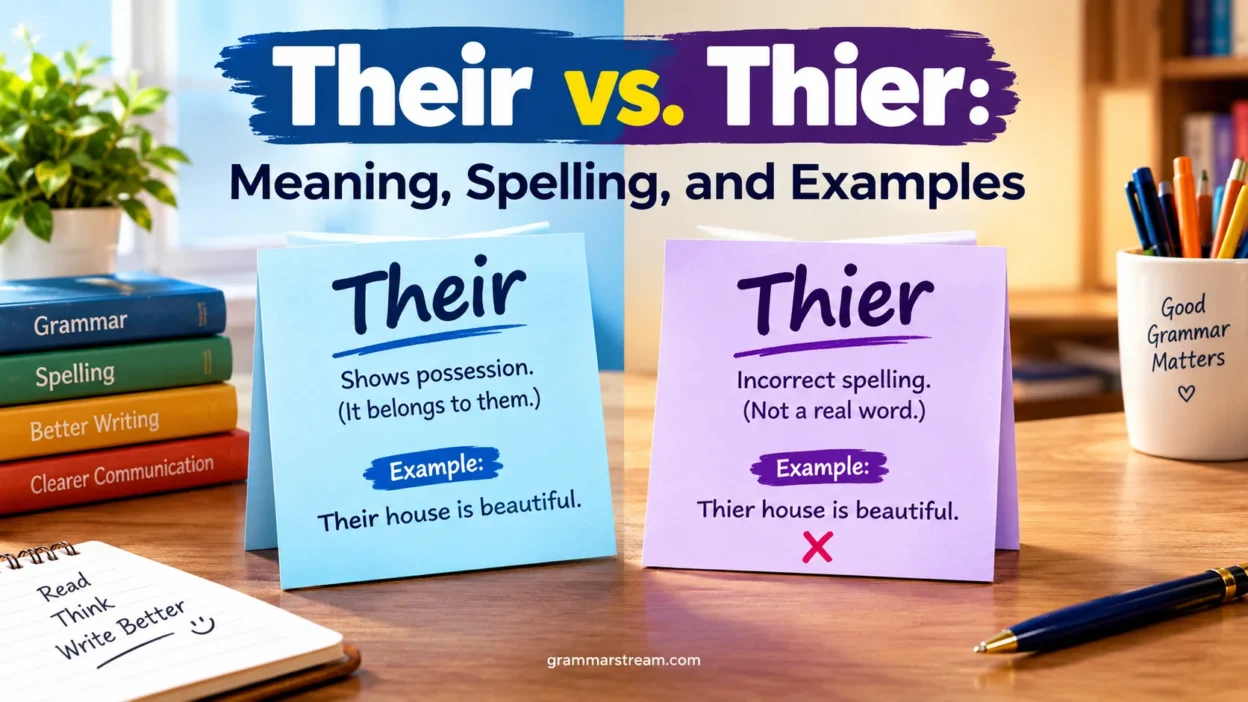
Their is the correct spelling, while thier is a misspelling in standard English. The word their is a possessive determiner that shows ownership, a relationship, or an association with someone or something. The spelling thier reverses the positions of the letters e and i and should generally be corrected.
- Correct: Their house has a beautiful garden.
- Incorrect: Thier house has a beautiful garden.
- Correct: The students submitted their assignments.
- Incorrect: The students submitted thier assignments.
Easy memory trick: Remember the spelling t-h-e-i-r. You can connect the word with the phrase “their things belong to them” to help remember its meaning.
Comparison Overview
The easiest way to understand their vs. thier is to compare their spelling, meaning, and usage. Although the two forms look similar, they do not have the same status in standard English.
| Feature | Their | Thier |
| Spelling | Correct | Incorrect |
| Standard English word | Yes | No |
| Meaning | Shows possession or association | No standard English meaning |
| Part of speech | Possessive determiner | Not a standard English part of speech |
| Pronunciation | Commonly /ðɛr/ in American English | No separate standard pronunciation |
| Correct usage | Formal and informal writing | Generally treated as a spelling error |
| Example | Their car is outside. | Thier car is outside. |
| Recommendation | Use this spelling | Correct it to their |
The central difference is simple: their is a real English word, but thier is a misspelling of that word in ordinary writing. You should use their in essays, business communication, social media posts, emails, and other written material.
Main Differences Between Their and Thier
Meaning of Their
The word their indicates that something belongs to, relates to, or is associated with people or things. It commonly appears before a noun and helps identify the person or group connected to that noun.
For example, in the sentence “Their dog loves playing outside,” the word their connects the dog with the people being discussed. The sentence doesn’t identify the dog’s owners by name, but it makes the relationship clear.
Here are more examples:
- Their house stands near the river.
- The children packed their bags before leaving.
- The employees discussed their responsibilities.
- The neighbors invited us to their party.
- Everyone should protect their privacy.
In each sentence, their establishes a relationship between someone and something. That relationship might involve ownership, responsibility, family connections, or another form of association.
Importantly, their doesn’t always mean legal ownership. In “Their teacher explained the lesson,” the word identifies the teacher’s relationship with the students. It doesn’t mean the students own the teacher.
Meaning of Thier
Thier is a common misspelling of their. It does not have an accepted, ordinary meaning in standard contemporary English.
Writers often produce this spelling by placing the letters i and e in the wrong order. The intended word remains recognizable, but the spelling is incorrect.
Consider these examples:
- Incorrect: Thier parents arrived early.
- Correct: Their parents arrived early.
- Incorrect: We visited thier office yesterday.
- Correct: We visited their office yesterday.
- Incorrect: The players celebrated thier victory.
- Correct: The players celebrated their victory.
In each example, replacing thier with their fixes the spelling without changing the intended meaning.
You may encounter thier in online comments, text messages, handwritten notes, or unedited documents. Its appearance in published material doesn’t make it an accepted spelling.
Remember: Use their whenever you intend to express possession or association in standard English.
Spelling Differences Between Their and Thier
The difference between these spellings comes down to the order of two letters.
The correct spelling contains the letters t-h-e-i-r. The incorrect form contains t-h-i-e-r.
| Word | Letter sequence | Status |
| Their | T-H-E-I-R | Correct |
| Thier | T-H-I-E-R | Misspelling |
Notice how the first two letters and the final letter remain the same. Only the positions of e and i change.
This small difference explains why the mistake can slip past a writer who is typing quickly. Your eyes may recognize the general shape of the word without noticing the misplaced letters.
To avoid this problem, focus on the middle of the word when proofreading. Instead of scanning the entire sentence without attention, check whether the sequence reads E-I rather than I-E.
For example:
- T-H-E-I-R: Their books are on the desk.
- T-H-I-E-R: Thier books are on the desk.
A quick spelling check can prevent this mistake from appearing in an important email, school paper, or published article.
Pronunciation of Their and Thier
In American English, their is commonly pronounced /ðɛr/. It sounds like there and they’re in many American accents.
The opening sound, represented by /ð/, is the voiced “th” sound heard in words such as this and those. The vowel resembles the sound in air for many American speakers, followed by an r sound.
Because thier is a misspelling rather than a standard English word, it has no separate conventional pronunciation. Readers will generally interpret it as an attempt to write their.
This similarity can make the spelling confusion more difficult to notice. You cannot reliably distinguish their from thier by sound because the intended word is normally pronounced the same way.
The best solution is to memorize the spelling rather than rely on pronunciation.
When to Use Their
Use their when you want to show possession, association, or a relationship with a person or group. It normally appears before a noun or another word that modifies a noun.
Here are the main situations in which their is appropriate.
To show possession
- Their car is parked outside.
- The children cleaned their bedroom.
- The company updated their website.
To describe relationships
- Their mother works at a hospital.
- The students thanked their teacher.
- Their neighbors moved last month.
To describe responsibilities or associations
- The employees completed their training.
- The committee announced their decision.
- The athletes followed their coach’s instructions.
To refer to one person using singular they
- Someone left their phone on the table.
- Jordan said their meeting starts at noon.
- Every applicant should submit their form.
In the last group, their can refer to one person rather than multiple people. This usage is common in contemporary English and works in many everyday and professional contexts.
When Not to Use Thier
You should generally avoid thier in standard English because it is a spelling error.
The mistake can appear in several situations:
- School assignments: A misspelling can make an otherwise correct sentence look careless.
- Professional emails: Typos may distract readers from the message.
- Website content: Incorrect spelling can undermine the impression of careful editing.
- Social media posts: Readers may notice the error even when they understand the meaning.
- Business documents: Consistent spelling helps maintain a professional presentation.
For example, suppose you write, “Please send thier final report by Friday.” Your reader will probably understand the request, but the sentence still contains an error.
The corrected version is “Please send their final report by Friday.”
A spell-checking tool may flag thier as a typo. However, you should still proofread your work because automated tools do not catch every writing problem.
Read More Outting vs. Outing: Meaning, Spelling, and Examples
How to Use Their Correctly in Sentences
Understanding the definition is useful, but seeing their in different contexts makes the rule easier to apply. The following examples demonstrate how the word works in everyday English.
Their for Ownership
The most familiar use of their involves possession. It identifies something belonging to or connected with the people being discussed.
Consider these examples:
- Their dog sleeps beside the fireplace.
- The neighbors sold their old furniture.
- The children put their toys away.
- The students opened their textbooks.
- My friends forgot their tickets.
In each sentence, their appears before a noun and connects that noun with its owners or associated people.
However, possession doesn’t always mean that someone legally owns an object. In “The students opened their textbooks,” the word simply connects the textbooks with the students using them.
Their for Relationships and Associations
The word their also describes connections that don’t necessarily involve ownership. These connections can include family relationships, work responsibilities, friendships, and group membership.
For example:
- Their manager approved the proposal.
- The family welcomed their new baby.
- The team celebrated their victory.
- Their teacher explained the difficult question.
- The volunteers completed their assigned tasks.
In “Their teacher explained the difficult question,” the students don’t own their teacher. Instead, their identifies the relationship between the students and the teacher.
This distinction matters because their expresses association as well as possession. Recognizing both uses will help you understand more sentences correctly.
Their With Singular They
One common misconception is that their must always refer to multiple people. In modern English, the word can also refer to one person through singular they.
Writers commonly use singular they when a person’s gender is unknown, when gender isn’t relevant, or when the person uses they/them pronouns.
Examples include:
- Someone left their jacket in the conference room.
- Every student must bring their identification.
- The successful applicant will receive their schedule tomorrow.
- Taylor said their flight arrives at six.
- If a customer has a question, they can contact their representative.
In the first sentence, someone refers to one unidentified person. The word their naturally refers back to that person.
Likewise, every student is grammatically singular, but singular they is widely accepted in contemporary English. The phrase “Every student must bring their identification” is natural and clear.
When referring to a specific person, follow that person’s stated pronouns when you know them. This approach helps keep your writing accurate and respectful.
Their in Questions and Everyday Expressions
The word their appears naturally in questions, instructions, and casual conversation.
Examples include:
- Is that their car?
- Where did they leave their bags?
- Did you meet their parents?
- Everyone should respect their privacy.
- They finished their work before lunch.
- The children are waiting for their ride.
These examples show that their can appear in many sentence structures. Its function remains consistent even when the surrounding words change.
Whenever you’re unsure whether to use their, ask yourself whether the sentence refers to someone or something associated with the people or person being discussed.
If the sentence expresses that relationship, their may be the correct choice.
Common Reasons People Misspell Their as Thier
Although their is a familiar word, writers still make mistakes with its spelling. Understanding why the error happens can help you prevent it.
Typing Too Quickly
Fast typing is one possible reason people write thier instead of their. When you focus on composing a message quickly, your fingers may place letters in the wrong order.
This problem can occur even when you know the correct spelling. Familiar words are not immune to typing errors.
For example, you might type “Their meeting starts at nine” correctly in one email and accidentally write “Thier meeting starts at nine” in another.
The simplest solution is to review important messages before sending them. Pay particular attention to common words that you use automatically.
Confusion About English Spelling Patterns
English spelling contains patterns that can help learners, but those patterns also have exceptions.
You may have heard the phrase “i before e, except after c.” However, this guideline doesn’t apply to every English word.
The spelling of their uses the sequence e-i. Memorizing the word itself is more reliable than trying to apply a general spelling rule to every situation.
Other familiar words, such as receive, believe, and neighbor, also demonstrate why English spelling requires attention to individual words and their patterns.
When you encounter a word that repeatedly causes trouble, learn its exact spelling instead of relying entirely on a general rule.
FAQs:
Is Thier a Word?
No. Thier is not a standard English word in ordinary contemporary usage. It is generally a misspelling of their, which indicates possession or association.
For example, “Their house is beautiful” is correct, while “Thier house is beautiful” contains a spelling error.
Which Is Correct, Their or Thier?
Their is correct. The word follows the standard spelling sequence T-H-E-I-R.
The form thier reverses the positions of e and i. Unless you’re discussing the misspelling itself, use their in standard English writing.
Why Do People Spell Their as Thier?
People may write thier because they type quickly, transpose letters, or struggle to remember the correct spelling sequence.
The error can occur even when someone knows the word’s meaning. Proofreading and spell-checking can help catch it before publication.
How Do You Remember the Spelling of Their?
Memorize the sequence T-H-E-I-R and connect the word with possession.
The sentence “Their things belong to them” provides a useful reminder. You can also practice with familiar examples, such as “their house,” “their books,” and “their family.”
Can Their Refer to One Person?
Yes. Their can refer to one person when used with singular they.
For example, “Someone left their coat in the office” refers to one unidentified person.
Writers also use singular they when a person’s gender isn’t relevant or when the person uses they/them pronouns.
Conclusion:
The difference between their vs. thier comes down to one simple rule: their is the correct standard English spelling, while thier is a common misspelling. Use their to express possession, relationships, responsibilities, and other forms of association. Remember that the word can refer to multiple people or one person when used with singular they. If you struggle to remember the spelling, focus on the sequence T-H-E-I-R. The middle letters appear in the order E-I, not I-E.