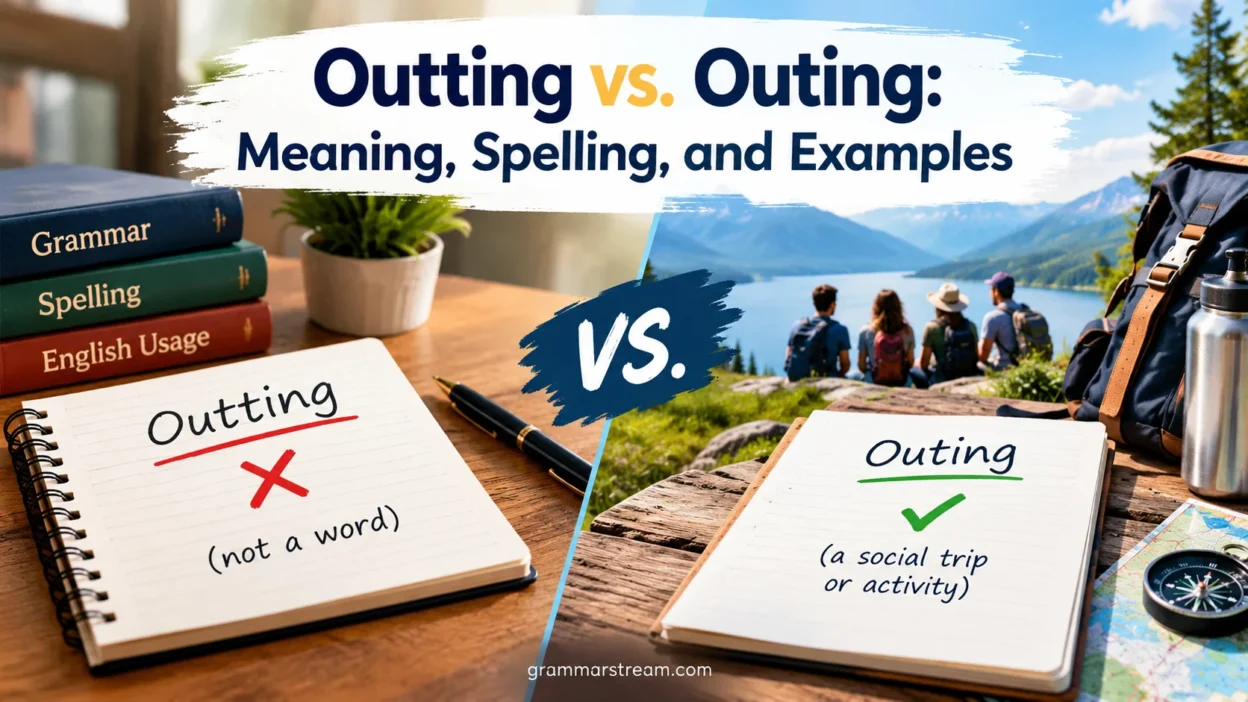
Have you ever wondered whether to write outting or outing? You’re not alone. Many English learners and native speakers occasionally add an extra letter when spelling familiar words. Although both forms look similar, only one is the standard spelling for the word most people intend to use.
The correct spelling is outing, with one t. It refers to a short trip, a recreational activity, or a social event. For example, you might plan a family outing to the beach or organize a company outing with your coworkers. The word can also describe the act of revealing someone’s private information, depending on the context.
But why do people write outting instead? The confusion often comes from English spelling rules, especially the rules for adding -ing to words. Understanding these rules will help you avoid this mistake in emails, school assignments, social media posts, and everyday conversations.
This guide explains the meanings of outing and outting, their spelling differences, grammar rules, pronunciation, and practical examples. You’ll also learn how to remember the correct spelling without second-guessing yourself.
Quick Answer: Outting vs. Outing
Outing is the correct standard spelling. Outting is generally a misspelling when someone intends to write outing. The word outing commonly means a short recreational trip or a social activity outside the usual routine. It can also refer to revealing someone’s private information, particularly their sexual orientation, without their consent.
| Word | Correctness | Meaning | Example |
| Outing | Correct | A recreational trip or social activity | We planned a family outing for Saturday. |
| Outting | Generally incorrect | A common misspelling of outing | We planned a family outting for Saturday. |
| Remember: The base word out already ends in a consonant followed by a consonant sound. When you add -ing, you keep the original spelling: out + ing = outing. |
Comparison Overview
Although outting and outing differ by only one letter, their standard usage isn’t the same. Understanding this distinction makes it easier to choose the right form when writing.
| Feature | Outting | Outing |
| Standard spelling | Incorrect for the intended word | Correct |
| Number of letters | Seven | Six |
| Number of t’s | Two | One |
| Common meaning | Usually a spelling error | A trip, excursion, or social activity |
| Part of speech | Not a standard form of the intended word | Noun; also the -ing form of the verb out |
| Standard dictionary usage | Not the standard spelling of outing | Established English word |
| Pronunciation | No separate standard pronunciation for the intended meaning | /ˈaʊtɪŋ/ |
| Example | We enjoyed the outting. | We enjoyed the outing. |
The key difference is spelling rather than meaning. In ordinary writing, you should use outing when referring to a trip or the act of revealing information about someone.
For example:
- Correct: Our school organized an outing to the science museum.
- Incorrect: Our school organized an outting to the science museum.
The second sentence contains a spelling mistake. Replacing outting with outing corrects it.
What Does Outing Mean?
The word outing has several established meanings in English. Its precise meaning depends on how someone uses it in a sentence.
Most commonly, an outing involves leaving home, school, or work to enjoy an activity somewhere else. However, the word can also describe the disclosure of information about another person.
Outing as a Short Trip or Excursion
An outing is a trip that people take for pleasure, recreation, education, or a shared experience. It often lasts a few hours or a day rather than involving an extended vacation.
For example, a family might visit a wildlife park on Sunday afternoon. A school might take students to a historical site. Friends might spend an evening bowling together.
All these activities can qualify as outings.
Consider these examples:
- We went on a family outing to the beach.
- The students enjoyed their outing to the local aquarium.
- Our weekend outing included lunch and a walk through the park.
- The hiking club organized an outing in the mountains.
- Their first outing together was a visit to an art gallery.
An outing doesn’t have to involve expensive travel or a distant destination. Even a short visit to a nearby attraction can qualify.
The main idea is a planned activity away from your usual surroundings, often for enjoyment or a shared purpose.
Outing as a Social Activity
People also use outing to describe group activities that help them spend time together.
These activities may take place among relatives, friends, classmates, or coworkers. They can be informal gatherings or organized events.
Common examples include:
- Family outing: A recreational activity involving family members.
- School outing: An organized trip for students and sometimes their teachers.
- Company outing: An activity arranged for employees to socialize outside their regular work environment.
- Group outing: An activity shared by several people.
- Friends’ outing: A social activity involving friends.
Imagine that a company arranges a picnic for its employees. The event gives coworkers an opportunity to relax, talk, and build relationships outside the office.
You could describe it this way: “Our annual company outing brought the entire team together.”
In this context, outing emphasizes the shared experience rather than the distance traveled.
Outing as the Act of Revealing Private Information
The word outing has another meaning that requires more care.
In this context, outing someone means revealing information about that person that they have not publicly disclosed. The term is especially associated with revealing someone’s sexual orientation or gender identity without their consent.
For example:
“Publishing her private information without permission resulted in a serious breach of trust.”
This meaning differs considerably from a recreational outing. The surrounding words usually make the intended meaning clear.
Compare these sentences:
- Recreational meaning: We enjoyed an outing to the countryside.
- Disclosure meaning: The article discussed the ethics of outing someone without consent.
The first sentence describes a trip. The second concerns privacy and personal information.
When writing about this subject, context matters because revealing sensitive personal information can expose someone to discrimination, harassment, or other harm.
What Does Outting Mean?
Outting is generally a spelling mistake when used as a substitute for the standard English word outing. Writers often make this error because they mistakenly believe the final consonant should be doubled before adding -ing.
For example:
- Incorrect: We’re planning a family outting.
- Correct: We’re planning a family outing.
The correction is straightforward. Remove the extra t.
Is Outting a Real Word?
In standard contemporary English, outting isn’t the accepted spelling of the noun outing or the usual -ing form of the verb out.
You might encounter outting in social media posts, informal messages, search queries, or text containing spelling errors. Its appearance doesn’t make it a standard alternative.
It’s also important to distinguish a spelling error from a deliberately coined word, a proper name, or a specialized form used in a particular context. Unusual letter sequences can appear in those settings.
However, if you want to describe a trip, excursion, or act of disclosure, outing is the standard form you should choose.
Why Do People Spell Outing as Outting?
English spelling contains several patterns that can be difficult to apply consistently. One common source of confusion is consonant doubling.
Some verbs double their final consonant when they take -ing.
For example:
- Run → running
- Sit → sitting
- Stop → stopping
- Swim → swimming
Because these forms use a doubled consonant, writers sometimes apply the same pattern to other verbs.
However, English spelling rules don’t require doubling the final consonant in every word ending in a consonant. The structure and spelling of the base word matter.
The word out doesn’t follow the same pattern as run or sit. Therefore, its standard -ing form is outing, not outting.
Read More: Genius vs. Genious: Meaning, Spelling, and Examples
Main Differences Between Outting and Outing
The difference between outting and outing becomes easier to understand when you examine their spelling, meaning, grammar, and pronunciation separately.
Spelling Differences Between Outting and Outing
The most obvious difference is the number of letters.
Outting contains seven letters, including two consecutive t’s. Outing contains six letters and only one t.
Compare their structure:
- Outting: O-U-T-T-I-N-G
- Outing: O-U-T-I-N-G
The extra t makes outting incorrect when you’re trying to write the standard word.
A simple way to check yourself is to identify the base word first.
The base word is out. Adding -ing gives you outing without changing the original spelling.
Meaning Differences Between Outting and Outing
The standard word outing has clear meanings in everyday English. It can describe a recreational excursion, a social activity, or the disclosure of someone’s private information.
By contrast, outting generally doesn’t represent a separate, established word with a different meaning in standard English.
Consider these examples:
Correct usage:
- The family planned an outing to the zoo.
- Our office outing included lunch and games.
- The documentary explored the consequences of outing someone without consent.
Incorrect usage:
- The family planned an outting to the zoo.
- Our office outting included lunch and games.
- The documentary explored the consequences of outting someone without consent.
In all three incorrect examples, the intended standard spelling is outing.
Grammar and Word Formation: Outting vs. Outing
The word outing can function as a noun or as the -ing form of the verb out.
As a noun, it describes an event or activity:
“My favorite summer outing was a trip to the lake.”
Here, outing names the activity.
As a verb form, it can describe revealing information about someone:
“The report discussed the risks of outing a person without permission.”
Here, outing functions as a gerund, the -ing form of a verb used in a noun-like role within the sentence.
The same spelling applies in both cases.
| Grammatical use | Example | Explanation |
| Noun | The outing lasted three hours. | Names an activity or trip |
| Noun modifier | We packed an outing bag. | Modifies the noun bag |
| Gerund | Outing someone without consent can violate their privacy. | Uses the -ing form of the verb out |
| Part of a phrase | Our family outing was memorable. | Forms part of a noun phrase |
Although the word has different grammatical uses, none requires the spelling outting.
Pronunciation Differences Between Outting and Outing
The standard pronunciation of outing is /ˈaʊtɪŋ/.
You can break it into two syllables:
- Out: The first syllable rhymes with shout.
- Ing: The second syllable has the familiar sound found in going and doing.
The stress falls on the first syllable.
Because outting isn’t the standard spelling of the intended word, it doesn’t have a separate standard pronunciation that distinguishes it from outing.
If you’re speaking rather than writing, listeners will generally understand the intended word from context. However, correct spelling remains important in formal and professional communication.
Examples of Correct and Incorrect Usage
Seeing the words in context makes the distinction easier to remember.
| Incorrect sentence | Correct sentence |
| We had a family outting yesterday. | We had a family outing yesterday. |
| The school planned an outting to the museum. | The school planned an outing to the museum. |
| Our company outting was enjoyable. | Our company outing was enjoyable. |
| They organized an outting for the weekend. | They organized an outing for the weekend. |
| The children loved their beach outting. | The children loved their beach outing. |
Notice that you don’t need to rewrite the entire sentence. Correcting the spelling is enough.
Why Is Outing the Correct Spelling?
The spelling of outing follows a straightforward word-formation pattern. Understanding that pattern can help you avoid similar mistakes.
The English Spelling Rule Behind Outing
To form the -ing version of a verb, English usually adds -ing to the base form. However, some words require spelling changes.
For example:
- Make → making
- Write → writing
- Dance → dancing
- Run → running
- Sit → sitting
- Play → playing
- Go → going
- Out → outing
Words ending in a silent e usually drop that letter before taking -ing. That’s why make becomes making rather than makeing.
Some short verbs also double their final consonant. For example, run becomes running and sit becomes sitting.
However, out doesn’t end in a silent e, and its spelling doesn’t require consonant doubling. You simply add -ing.
Out + ing = outing.
This is the standard form.
Why You Should Not Double the T in Outing
The final consonant doubling rule applies only under particular conditions. It doesn’t mean every verb ending in a consonant needs an extra letter.
Compare the following forms:
| Base word | Correct -ing form | Spelling pattern |
| Run | Running | Doubles the final consonant |
| Sit | Sitting | Doubles the final consonant |
| Stop | Stopping | Doubles the final consonant |
| Play | Playing | Keeps the original spelling |
| Go | Going | Keeps the original spelling |
| Out | Outing | Keeps the original spelling |
The verb out already has a fixed spelling. Adding -ing doesn’t create a reason to double its final letter.
This explains why outing is correct while outting is not the standard form.
FAQs:
Is Outting or Outing Correct?
Outing is the correct standard spelling. Outting is generally a misspelling when someone intends to refer to a recreational trip or the act of revealing information.
For example, write “We enjoyed a family outing,” not “We enjoyed a family outting.”
Why Is Outing Spelled With One T?
The word outing comes from the base word out with the ending -ing added. The spelling doesn’t require doubling the final consonant.
Therefore, the correct form is outing, not outting.
What Does Outing Mean in English?
An outing commonly means a short recreational trip or social activity away from your usual surroundings.
For example, a family visit to the beach or a school trip to a museum can qualify as an outing.
The word also refers to revealing someone’s private information, especially their sexual orientation or gender identity, without their consent.
Is Outting Ever Correct?
Outting isn’t the standard spelling of outing in ordinary contemporary English.
You may encounter it as a typo, a deliberate nonstandard spelling, or part of a specialized name. However, when you mean a trip, excursion, or act of disclosure, use outing.
What Is the Difference Between an Outing and a Trip?
An outing usually refers to a recreational or social activity. A trip is a broader term that can describe travel for business, education, pleasure, or other purposes.
For example, visiting a park with friends is an outing. Traveling to another city for a business meeting is generally a business trip.
The terms sometimes overlap, but their emphasis differs.
Conclusion:
The difference between outting vs. outing is simple: outing is the correct standard spelling, while outting is generally an incorrect form of the intended word. An outing can describe a family trip, a school excursion, a company activity, or another recreational experience. It can also refer to revealing someone’s private information, depending on the context. The spelling rule is straightforward. Start with the base word out and add -ing without doubling the final consonant.