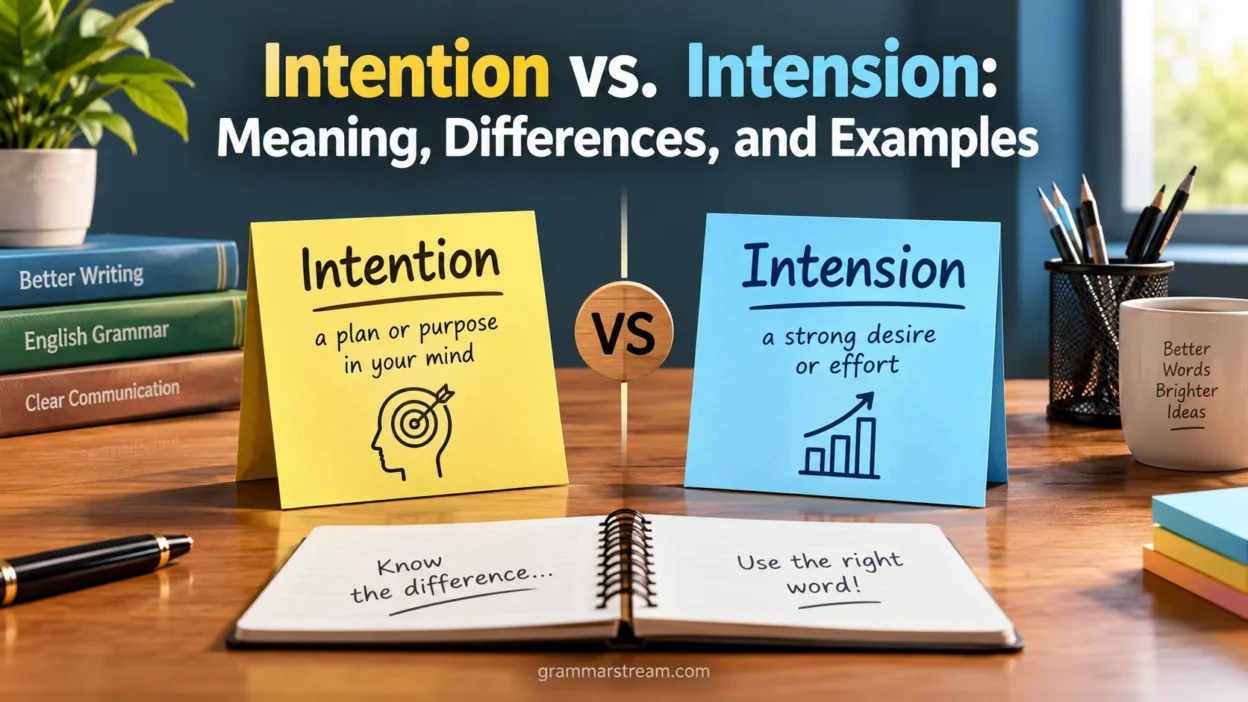
Intention vs. Intension can be confusing because these words have a similar spelling, a similar sound, and a nearly identical appearance, yet they have different meanings. The spelling difference is only one letter, but each word has a different purpose in written English and spoken language. Intention refers to a purpose, goal, aim, or planned action that explains what someone plans to do.
For example, your intention to help a friend, intention of learning a new skill, or intention to apply for a new job describes an intended purpose. You might discuss personal goals, career plans, a planned activity, a job application, or starting a business in daily conversations, casual communication, business emails, and professional communication. Careful writers consider the context and word choice to select the correct word.
This helps prevent incorrect usage, unclear writing, word confusion, and other writing errors while improving clear expression, communication clarity, and accurate communication. Learning the basic definitions, word meanings, and meaning distinction also strengthens writing accuracy, grammar, English grammar, vocabulary, and overall language usage.
Quick Answer:
Intention means a plan, purpose, or aim to do something. Intension refers to the defining meaning, properties, or conditions associated with a concept, particularly in logic, philosophy, and semantics.
Here are two examples that show the difference:
- Intention: “My intention is to finish the assignment before Friday.” This sentence describes a plan or goal.
- Intension: “The intension of the term triangle includes the properties that define a three-sided polygon.” This sentence discusses the meaning of a concept.
The easiest way to remember the distinction is to think about what each word describes. If you’re talking about what someone plans to do, use intention. If you’re discussing the defining characteristics of a concept, intension may be the correct word.
| Word | Meaning | Example |
| Intention | A plan, purpose, or aim | My intention is to improve my writing. |
| Intension | The defining meaning or characteristics of a concept | The intension of triangle includes its defining geometric properties. |
Quick tip: When writing everyday English, intention is almost always the word you need unless you’re discussing a specialized concept.
Comparison Overview
Although intention and intension differ by only one letter, their meanings and applications are distinct. Understanding these differences helps you choose the right word without second-guessing yourself.
| Feature | Intention | Intension |
| Part of speech | Noun | Noun |
| Primary meaning | A plan, aim, or purpose | The defining meaning or characteristics of a concept |
| Main subject | Human plans, goals, and purposes | Concepts, definitions, and linguistic meaning |
| Common fields | Everyday English, business, education, psychology, and law | Logic, philosophy, linguistics, and semantics |
| Everyday usage | Very common | Uncommon |
| Example phrase | Good intentions | Intension and extension |
| Related adjective | Intentional | Intensional |
| Plural form | Intentions | Intensions |
| Typical sentence | “Her intention was to help.” | “The philosopher examined the intension of the concept.” |
The main difference concerns purpose versus conceptual meaning. Intention describes what someone plans or means to accomplish. Intension describes the meaning-related properties associated with a concept.
For example, if you plan to become a teacher, your plan represents an intention. If you study the defining characteristics of the concept teacher, you might encounter a discussion of intension in a technical context.
Neither word is inherently more correct than the other. The appropriate choice depends entirely on what you want to express.
What Does Intention Mean?
Intention is a noun that describes a person’s plan, purpose, aim, or intended course of action. It explains what someone wants or plans to accomplish, whether or not that person eventually succeeds.
People use the word intention in everyday conversations, workplace discussions, academic writing, relationships, and formal statements. It can describe a simple plan, such as calling a friend, or a larger objective, such as launching a company.
Consider this sentence:
“My intention is to save enough money to buy a house.”
Here, intention describes a goal the speaker wants to achieve. The sentence doesn’t guarantee that the person will buy a house. It simply communicates the person’s purpose or plan.
An intention can also describe the reason behind an action. For example, someone might apologize with the intention of repairing a friendship. Another person might ask a question with the intention of understanding a difficult subject.
In both cases, the word explains the purpose behind the action.
Definition of Intention
The word intention refers to a plan, aim, purpose, or objective that someone has in mind.
It often describes a future action, but it can also explain the purpose behind something that has already happened. For instance, a person might explain their original intention after others misunderstand their behavior.
Here are some important characteristics of intention:
- Purpose: It explains why someone wants to do something.
- Planning: It can describe an action someone expects or hopes to take.
- Motivation: It can help explain the reason behind a decision or behavior.
- Deliberation: It may involve a conscious decision, although people can form intentions with different levels of planning.
- Outcome: An intention doesn’t guarantee that the intended action will happen.
Suppose you intend to exercise every morning. You have a clear plan, but unexpected responsibilities might prevent you from following it.
Your intention still existed even though the outcome differed from your original plan.
It’s also important to distinguish intention from action. Intending to do something isn’t the same as actually doing it. Someone can genuinely intend to help but fail to follow through.
Examples of Intention in Sentences
The best way to understand intention is to see how it works in different situations.
Here are several examples with explanations.
- “My intention is to learn Spanish this year.” The speaker has a personal learning goal.
- “She had no intention of hurting his feelings.” The sentence explains that causing emotional pain wasn’t part of her purpose.
- “The company announced its intention to open three new stores.” The word describes a planned business action.
- “His original intention was to stay for one week.” This sentence refers to the person’s initial plan.
- “They acted with good intentions.” The phrase suggests that their motives were positive.
- “I had every intention of calling you yesterday.” The speaker planned to call but may not have followed through.
- “The committee expressed its intention to review the proposal.” The sentence communicates a planned future action.
- “Her intention was to make the instructions easier to understand.” The word explains the purpose behind her work.
Notice how every example concerns a plan, purpose, motive, or intended action. None discusses the defining meaning of a concept.
That distinction makes intention relatively easy to recognize in everyday writing.
Read More: Ladel vs. Ladle: Correct Spelling, Meaning, and Examples
Common Expressions With Intention
English uses intention in several common phrases. Learning these expressions can help you write more naturally.
With the intention of
This phrase explains the purpose behind an action.
Example: “He enrolled in the course with the intention of improving his technical skills.”
The phrase connects the action of enrolling with the goal of developing new skills.
Intention to do something
This construction identifies an action someone plans or expects to take.
Example: “The manager has no intention to cancel the project.”
In this sentence, the phrase communicates the manager’s position regarding a possible future action.
Good intentions
This expression describes positive motives or a desire to do something helpful.
Example: “She offered advice with good intentions, even though it wasn’t what he wanted to hear.”
The phrase focuses on the motive behind the advice rather than its actual effect.
Original intention
This expression refers to the initial purpose or plan.
Example: “Our original intention was to finish the renovation in June.”
The word original emphasizes that the plan existed before any later changes.
Intention of doing something
This construction can also describe a person’s purpose.
Example: “She had no intention of leaving her team without support.”
The phrase makes the person’s intended behavior clear.
These expressions appear frequently in conversations, professional documents, essays, and everyday writing. Understanding them also makes it easier to identify when intention is the appropriate choice.
What Does Intension Mean?
Intension is a noun used primarily in logic, philosophy, linguistics, and semantics. It refers to the defining meaning, properties, or conditions associated with a concept or expression.
Unlike intention, intension doesn’t ordinarily describe someone’s plans or motives. Instead, it helps explain what a concept means and what characteristics define it.
For example, consider the word triangle. In geometry, a triangle is a polygon with three sides. Those defining properties help distinguish triangles from squares, circles, and other geometric figures.
In a discussion of concepts and definitions, the properties associated with being a triangle can illustrate its intension.
The word becomes particularly useful when researchers investigate how expressions refer to things, how meanings differ, and how definitions determine which objects belong to a category.
However, intension doesn’t have one identical technical definition across every academic framework. Its precise interpretation can depend on the theory being discussed.
For general readers, the essential point is simple: intension concerns conceptual meaning rather than a person’s intended actions.
Definition of Intension
In its technical sense, intension refers to the meaning-related content or defining characteristics associated with a concept or expression.
One helpful way to understand it is to ask what makes something qualify as a particular kind of thing.
Consider the concept bachelor. In its traditional dictionary sense, a bachelor is an unmarried man. The characteristics expressed in that definition help explain the concept’s intension.
Now consider bird. Depending on the definition and theoretical framework, its intension may involve properties associated with being a bird, while its extension includes the individual birds that fall under the concept.
This distinction matters because the meaning of a concept and the things that fit that concept aren’t the same thing.
Here are some important points about intension:
- Conceptual meaning: It concerns the meaning associated with a term or concept.
- Defining characteristics: It can involve properties or conditions used to identify a concept.
- Technical application: It appears in discussions of logic, philosophy, linguistics, and formal semantics.
- Relationship to extension: It is often contrasted with the objects or cases that fall under a term.
- Theoretical variation: Different approaches may explain intension in different ways.
In formal semantics, for example, an expression’s intension may be modeled as a function that assigns an extension to that expression across possible worlds or circumstances.
That technical approach allows researchers to study how an expression’s meaning relates to what it refers to under different conditions.
You don’t need to master formal semantics to understand the basic difference between intension and intention. You simply need to recognize that the former concerns conceptual meaning.
Examples of Intension in Sentences
Because intension is uncommon in everyday conversation, examples provide a useful way to understand its proper context.
- “The philosopher examined the intension of the concept.” The sentence concerns the defining meaning of an idea.
- “In formal semantics, researchers distinguish a term’s intension from its extension.” The word describes a technical distinction between meaning and reference.
- “The intension of ‘bachelor’ is associated with the defining meaning of an unmarried man.” The sentence discusses the characteristics expressed by a concept’s definition.
- “The researchers compared the intensions of two related concepts.” The sentence concerns differences between conceptual meanings.
- “The paper explores how intensions behave in different possible worlds.” This example refers to a technical approach used in philosophical logic and semantics.
- “The course introduces students to intensional logic.” The related adjective describes a specialized area of logic.
These examples share an important feature: they discuss meanings, concepts, definitions, or formal systems.
You wouldn’t normally use intension to describe your plan to finish homework, call a friend, or start a business. Those situations require intention.
Where Is Intension Used?
Although intension rarely appears in casual conversation, it serves a useful purpose in several academic fields.
Logic
In logic, intension can help explain how the meaning of an expression relates to what it applies to. Some logical systems distinguish expressions by their meaning even when those expressions refer to the same objects.
This distinction becomes useful when studying formal languages, logical relationships, and the interpretation of statements.
Philosophy
Philosophers use the concept of intension when examining meaning, definitions, concepts, and the conditions under which statements hold.
For example, a philosophical discussion might compare two expressions that refer to the same object but convey different information.
The distinction between meaning and reference helps clarify why those expressions might not be interchangeable in every context.
Linguistics and semantics
In linguistics, semantics examines meaning in language. Intension can help researchers analyze the meanings of words and expressions independently of the particular objects they refer to.
For example, two expressions might refer to the same person while expressing different meanings. Studying those meanings can reveal distinctions that a list of referents alone wouldn’t capture.
Formal semantics
Formal semantics often uses mathematical models to represent linguistic meaning.
In some frameworks, an expression’s intension is represented as a function from possible worlds to extensions. Its extension can vary depending on the world or circumstances under consideration.
This is a more technical use of the term, so the details depend on the framework being studied.
For everyday writers, the takeaway is straightforward: intension is a legitimate word, but its specialized meaning makes it unnecessary in most ordinary sentences.
Main Differences Between Intention and Intension
The difference between intention and intension becomes clearer when you compare their meanings, contexts, and grammatical forms.
Both are nouns, and both contain the letters intenti- or intensi- near the beginning. However, their similarities largely end there.
Intention describes a purpose. Intension describes conceptual meaning.
Let’s examine their main differences more closely.
FAQs:
What Is the Main Difference Between Intention and Intension?
Intention refers to a plan, purpose, or aim behind an action. Intension describes the defining characteristics or conceptual meaning of a term, especially in logic, philosophy, and semantics. The correct choice depends on the context.
Is Intension a Real Word?
Yes, intension is a legitimate English word. It appears mainly in specialized academic discussions about concepts, meanings, and logical relationships. It isn’t a spelling mistake, even though it’s less common than intention.
How Do You Use Intention in a Sentence?
Use intention when describing what someone plans or hopes to do. For example, “My intention is to learn a new skill this year.” The word expresses a personal goal, purpose, or planned action.
When Should You Use Intension?
Use intension when discussing the defining properties or conceptual meaning of a term. For example, in philosophy or semantics, researchers may examine a concept’s intension to understand the characteristics that define it.
How Can You Remember the Difference Between Intention and Intension?
Remember that intention relates to what you intend to do, while intension relates to the meaning or defining properties of a concept. Connecting each word to its purpose makes the distinction easier to remember.
Conclusion:
Understanding intention vs. intension helps you choose the right word for your writing. Intention is the everyday choice when discussing plans, goals, and purposes. Intension belongs mainly to technical discussions in logic, philosophy, semantics, and linguistics. Although the words look similar, their meanings differ. Pay attention to context, and you’ll be able to use both terms accurately in everyday communication and academic writing.