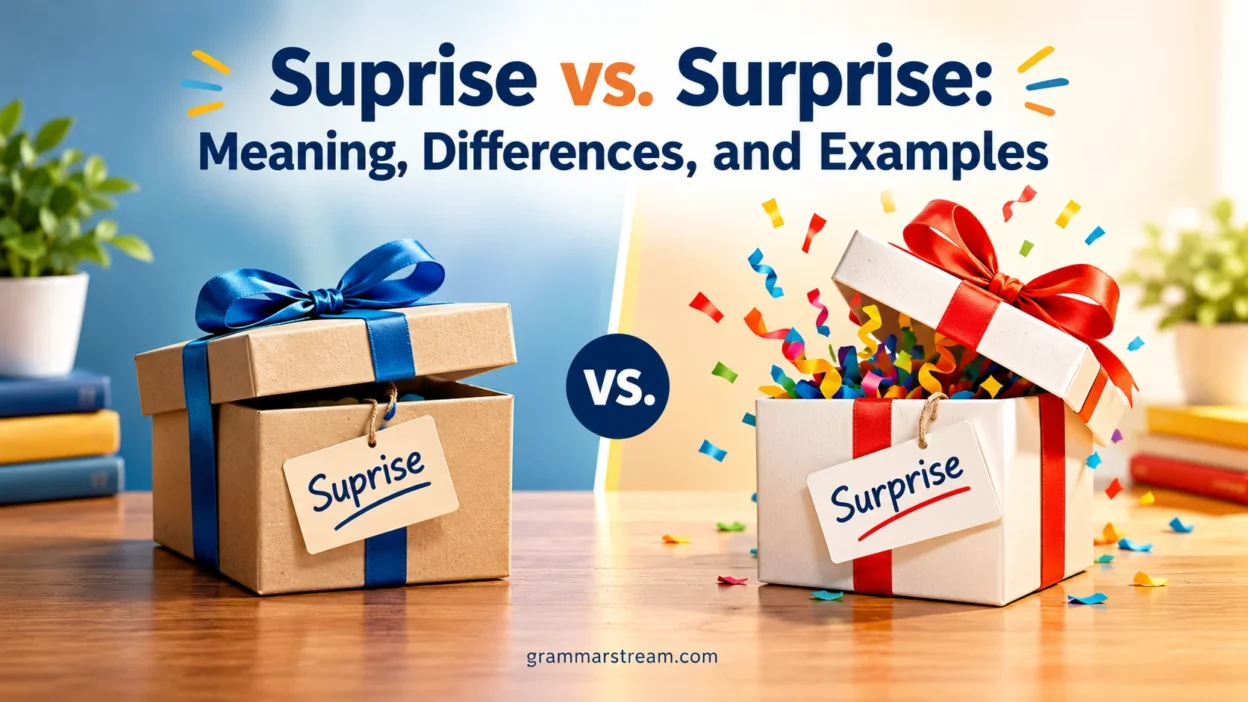
Have you ever typed suprise and wondered whether it was correct? You’re not alone. Many people accidentally leave out a letter when spelling this common English word. Although both versions may look familiar, only one is correct in standard English. Understanding the difference will help you write more confidently in emails, school assignments, articles, and everyday conversations.
The correct spelling is surprise, with two instances of the letter r. The spelling suprise is a common misspelling that occurs when writers accidentally omit the first r. Both spellings might appear in online searches, text messages, and social media posts, but that doesn’t make them equally acceptable.
In this guide, you’ll learn the correct spelling, meaning, pronunciation, grammatical forms, and common mistakes associated with suprise vs. surprise. You’ll also discover practical ways to remember the correct spelling and use the word naturally in different situations.
Quick Answer:
Surprise is the correct spelling in standard American English. Suprise is a misspelling because it leaves out the first letter r. Use surprise whenever you want to describe something unexpected or the feeling caused by an unexpected event.
| Word | Correct or Incorrect? | Meaning |
| Surprise | Correct | Something unexpected or the act of causing astonishment |
| Suprise | Incorrect | A misspelling of surprise |
Correct example: The surprise birthday party made everyone smile.
Incorrect example: The suprise birthday party made everyone smile.
Corrected sentence: The surprise birthday party made everyone smile.
Remember the spelling pattern: S-U-R-P-R-I-S-E. The word contains two instances of the letter r. Remembering both will help you avoid this common mistake.
Comparison Overview
The difference between suprise and surprise is straightforward. One follows standard English spelling conventions, while the other omits a letter.
| Feature | Surprise | Suprise |
| Spelling | Correct | Incorrect |
| Number of letters | 8 | 7 |
| Contains two instances of r | Yes | No |
| Standard English meaning | Something unexpected or to cause astonishment | No separate standard meaning |
| Correct in American English | Yes | No |
| Correct in British English | Yes | No |
| Suitable for formal writing | Yes | No |
| Suitable for professional emails | Yes | No |
| Example | The news came as a surprise. | The news came as a suprise. |
The most important distinction is the missing letter. Surprise contains eight letters, while the misspelling suprise contains only seven.
You should use surprise in every ordinary English context, whether you’re writing a school essay, publishing a blog post, or sending a message to a friend. The misspelled version should be corrected unless it appears intentionally as a name or stylized brand.
Main Differences Between Suprise and Surprise
The difference between suprise vs. surprise becomes easier to understand when you examine their spelling, meaning, and usage separately.
Surprise Is the Correct Spelling
Surprise is the standard English spelling. It refers to something unexpected, a feeling of astonishment, or an action that causes someone to experience that feeling.
For example, consider this sentence:
The unexpected announcement came as a surprise to everyone.
Here, surprise describes the unexpected nature of the announcement.
The word also functions as a verb. For example, “We plan to surprise our mother with flowers.” In this sentence, surprise describes the action of causing someone to feel unexpected happiness or astonishment.
Suprise Is a Misspelling
Suprise is not the standard spelling of the English word. It omits the first r from the correct spelling.
You might encounter this mistake in comments, social media captions, search queries, or informal messages. However, its appearance online doesn’t make it an accepted spelling.
For example:
- Incorrect: “I have a suprise for you.”
- Correct: “I have a surprise for you.”
The corrected sentence contains the proper spelling and communicates the intended meaning clearly.
The Two Spellings Have No Separate Standard Meanings
Unlike word pairs such as affect and effect, these spellings don’t represent two different English words with distinct meanings.
Instead, suprise is simply an error in spelling. It doesn’t have a separate standard definition that you need to memorize.
This makes the choice easy. Whenever you mean something unexpected or want to describe the act of surprising someone, choose surprise.
What Does Surprise Mean?
The word surprise describes something unexpected or the feeling that occurs when an event happens differently from what someone anticipated.
A surprise can create happiness, excitement, confusion, fear, or disappointment. Its emotional effect depends on the situation.
For example, receiving an unexpected birthday gift might make you happy. Discovering an unexpected charge on your bank statement might leave you worried instead.
The word has several common uses in English, including as a noun and a verb.
Surprise as a Noun
As a noun, surprise refers to an unexpected event, discovery, gift, or feeling.
People often use the word when discussing celebrations, sudden announcements, and unplanned experiences.
Consider these examples:
- Birthday gift: “Her friends prepared a wonderful surprise for her birthday.”
- Unexpected news: “The promotion came as a complete surprise.”
- Personal discovery: “To my surprise, I found my missing keys inside the drawer.”
- Social event: “The family organized a surprise party for their grandparents.”
- Emotional reaction: “His expression showed genuine surprise.”
In each example, the word identifies something unexpected or the feeling associated with it.
The noun can also appear in familiar expressions such as a pleasant surprise, a complete surprise, and to someone’s surprise.
For example, “To everyone’s surprise, the youngest player won the competition.” This sentence emphasizes that the result wasn’t what people expected.
Surprise as a Verb
As a verb, surprise means to cause someone to feel astonished or to encounter someone unexpectedly.
The verb can describe a planned action or an unexpected event.
Here are several examples:
- “We decided to surprise our father with breakfast.”
- “The unexpected results surprised the researchers.”
- “Her progress continues to surprise her teachers.”
- “I didn’t want to surprise him during the meeting.”
- “The sudden visit surprised everyone at home.”
Notice how the word changes according to the subject and tense.
In “We surprise our friends every year,” the verb describes a regular action. In “We surprised our friends yesterday,” the past-tense form describes an action that already happened.
Both sentences use the correct spelling of the word.
Surprise in Compound Expressions
The word surprise frequently appears before another noun to describe an unexpected event, person, or experience.
Examples include:
- Surprise party: A celebration organized without the guest of honor’s prior knowledge.
- Surprise guest: Someone who arrives unexpectedly.
- Surprise announcement: News that people didn’t anticipate.
- Surprise visit: An unplanned visit.
- Surprise ending: An unexpected conclusion to a story, film, or performance.
In these expressions, surprise functions as a noun that modifies another noun.
For example, “They planned a surprise dinner for their parents.” The word tells readers that the dinner is intended to be unexpected.
Why Is Surprise the Correct Spelling?
The correct spelling follows the established English form of the word. It contains eight letters arranged in this order: S-U-R-P-R-I-S-E.
The misspelling suprise occurs when writers leave out the first r. Although this may seem like a tiny difference, spelling accuracy matters because readers expect familiar words to follow standard conventions.
Understanding the Letter Order in Surprise
Let’s break the word into its individual letters:
S – U – R – P – R – I – S – E
The two instances of r are particularly important. The first appears after u, while the second appears after p.
The sequence R-P-R is a useful visual reminder because it’s the part that distinguishes the correct spelling from the common mistake.
Compare the two forms:
- Correct: SURPRISE
- Incorrect: SUPRISE
When you write the incorrect version, the first r disappears. Checking the letter sequence before submitting your work can help you catch the error.
Why Do People Misspell Surprise?
Several factors can contribute to this spelling mistake.
First, people sometimes type faster than they think. When writing quickly, you might accidentally skip a letter without noticing it.
Second, pronunciation doesn’t always make spelling obvious. English spelling reflects a long history of language development. The relationship between sounds and letters isn’t always simple or predictable.
Third, visual familiarity can be misleading. After seeing a misspelled word repeatedly, you might begin to recognize it without realizing that it’s incorrect.
Finally, spell-checking habits can affect accuracy. If you don’t review your writing carefully, a small error may remain in a published article or professional message.
The solution is simple: learn the correct letter sequence and check your writing before sharing it.
Is Suprise Ever Correct?
In ordinary English writing, suprise is incorrect. It isn’t an accepted alternative spelling of surprise in standard American or British English.
However, you might encounter the spelling as an intentionally chosen name, username, fictional label, or stylized brand.
For example, a person might choose Suprise123 as a username. In that case, the spelling is a deliberate name rather than a correct use of the standard English word.
This distinction matters because proper names and brand names can use unconventional spellings. Such choices don’t change the accepted spelling of the ordinary word.
For schoolwork, professional communication, articles, and other standard writing, always use surprise.
How to Pronounce Surprise
The standard American English pronunciation of surprise is commonly represented in the International Phonetic Alphabet as /sɚˈpraɪz/. A broader transcription is /sərˈpraɪz/.
The word has two syllables, and the primary stress falls on the second syllable.
Pronunciation can help you recognize the word when speaking, but it shouldn’t replace learning its spelling.
Surprise Pronunciation in American English
In American English, surprise is pronounced with a reduced first syllable followed by a stressed second syllable.
The pronunciation includes these main features:
- Two syllables: The word has two spoken syllables.
- Second-syllable stress: The strongest emphasis falls on the second syllable.
- The opening sound: The first syllable contains a reduced vowel in common American pronunciations.
- The ending: The final sound is a voiced /z/.
The spelling includes two instances of r, but you shouldn’t expect each written letter to correspond to a separate, clearly distinguishable sound.
This is one reason spelling by sound alone can be unreliable. Learning the conventional written form remains important.
Why Pronunciation Can Lead to Spelling Mistakes
When people speak quickly, they may not consciously notice every sound or letter associated with a word.
As a result, someone who knows the word’s meaning and pronunciation might still write suprise by mistake.
This doesn’t mean the incorrect spelling is a valid phonetic alternative. It simply shows that recognizing a spoken word and spelling it correctly are different skills.
For example, you might understand the sentence “I have a surprise for you” immediately when someone says it aloud. However, writing the sentence requires you to remember the correct letter sequence.
Reading, writing, and proofreading the word in different contexts can help strengthen that connection.
Examples of Surprise in Sentences
Examples make it easier to understand how a word works in everyday communication. The following sentences demonstrate the correct use of surprise as a noun and a verb.
Surprise Used as a Noun
When surprise functions as a noun, it names an unexpected event, discovery, or reaction.
Here are some practical examples:
- “The surprise made her birthday unforgettable.”
- “His visit was a complete surprise.”
- “To my surprise, the package arrived early.”
- “The children prepared a surprise for their teacher.”
- “Winning the competition was a wonderful surprise.”
- “Everyone reacted with surprise when the lights suddenly went out.”
- “The final chapter contains a surprise that changes the entire story.”
- “Much to our surprise, the restaurant was nearly empty.”
Each sentence uses surprise to describe something unexpected or a reaction to an unexpected event.
Notice the expression “to my surprise.” Writers commonly use it to introduce information that contrasts with their expectations.
For example, “To my surprise, the difficult exam was easier than I expected.” The expression highlights the difference between what the speaker anticipated and what actually happened.
FAQs:
Is Suprise a Word?
Suprise isn’t the standard spelling of the English word surprise. It usually appears as a spelling mistake caused by omitting the first r. In ordinary writing, use surprise instead.
Which Is Correct, Suprise or Surprise?
Surprise is correct. It contains eight letters, including two instances of r. The spelling suprise contains only seven letters because it omits the first r.
Why Do People Spell Surprise as Suprise?
People often make this mistake when typing quickly or relying on their memory of the word’s pronunciation. The unusual letter sequence can also make the spelling easy to forget. Remembering both instances of r helps prevent the error.
How Do You Spell Surprise Correctly?
The correct spelling is S-U-R-P-R-I-S-E. Pay particular attention to the sequence R-P-R. That pattern helps distinguish the correct spelling from the common misspelling.
Is Surprise Spelled the Same Way in American and British English?
Yes. Both American and British English use surprise. Neither variety treats suprise as the standard spelling. The same spelling applies to related forms such as surprised and surprising.
Conclusion:
When comparing suprise vs. surprise, there’s one clear answer: surprise is the correct spelling in standard English. The alternative suprise is a misspelling that omits the first r. The word surprise can function as both a noun and a verb. It also appears in related forms such as surprised, surprising, and surprisingly. Although these forms have different grammatical uses, they retain the correct spelling pattern.