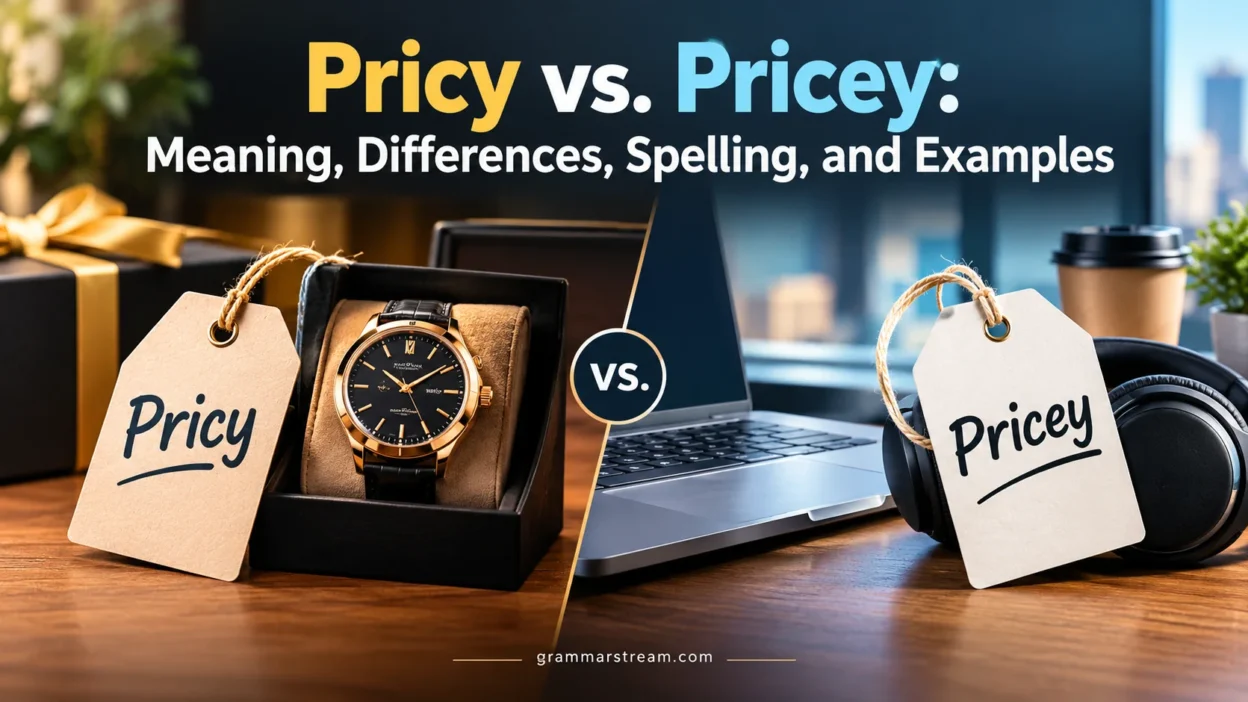
Have you ever wondered whether pricy or pricey is the correct spelling when describing something expensive? You’re not alone. These two words look slightly different, yet they share the same meaning. Choosing the right spelling can feel confusing, especially when both forms appear in English writing.
The good news is that both pricy and pricey are correct English words. They function as adjectives and describe something that costs a lot of money. However, pricey is the more common spelling in modern American English, making it the safer choice for most readers.
Although the difference seems small, understanding these spellings helps you write more confidently. Whether you’re reviewing a restaurant, discussing an expensive purchase, or creating an article about shopping, knowing how to use these words correctly makes your writing clearer.
This guide explains the meaning of pricy and pricey, their spelling differences, pronunciation, everyday usage, synonyms, and common mistakes. You’ll also find practical examples and comparisons to help you choose the right word for any situation.
Quick Answer: Pricy vs. Pricey
Both pricy and pricey are correct spellings of an adjective meaning expensive or costly. They have the same basic meaning and pronunciation. However, pricey is more widely used in contemporary American English and is generally the better choice for everyday writing.
Here’s a quick comparison:
| Feature | Pricy | Pricey |
| Correct spelling | Yes | Yes |
| Meaning | Expensive or costly | Expensive or costly |
| Part of speech | Adjective | Adjective |
| Pronunciation | /ˈpraɪ.si/ | /ˈpraɪ.si/ |
| Meaning difference | None | None |
| General usage | Less common | More common |
| Suitable for everyday writing | Yes | Yes |
| Suitable for American English | Yes | Yes |
| Example | That jacket looks pricy. | That jacket looks pricey. |
Which spelling should you choose?
Use pricey when you want the more familiar spelling. Choose pricy if it matches your established writing style or a publication’s preferred spelling.
For example:
- Pricey: The hotel was too pricey for our vacation budget.
- Pricy: The hotel was too pricy for our vacation budget.
Both sentences are grammatically correct and communicate the same idea.
Comparison Overview
The main difference between pricy and pricey involves spelling and usage frequency rather than meaning. Both words describe something expensive, whether it’s a product, service, meal, vacation, or experience.
English sometimes allows multiple spellings for the same word. These variations don’t always represent different meanings. In this case, the two forms are interchangeable in ordinary writing.
| Comparison Point | Pricy | Pricey |
| Definition | Costing a lot of money | Costing a lot of money |
| Grammatical role | Adjective | Adjective |
| Spelling | Omits the second e in price before -y | Retains the e in price before -y |
| Pronunciation | Same as pricey | Same as pricy |
| Common contexts | Conversations, reviews, general writing | Conversations, reviews, general writing |
| Usage frequency | Less common | More common |
| Emotional tone | Can suggest a high or inconvenient price | Can suggest a high or inconvenient price |
| Meaning of quality | Doesn’t automatically describe quality | Doesn’t automatically describe quality |
| Recommended general choice | Acceptable alternative | Preferred for most readers |
Consider two shoppers discussing a new smartphone.
One says, “That phone looks pricey.”
The other replies, “Yes, it’s a little pricy for my budget.”
Neither person has made a spelling mistake. They have simply chosen different forms of the same adjective.
It’s also important to distinguish pricey from overpriced. A product can be pricey because it costs a lot, but overpriced suggests that its cost exceeds what someone considers reasonable for its value.
That distinction matters when describing purchases, comparing products, or writing reviews.
What Does Pricy Mean?
Pricy is an adjective that means expensive or costing a relatively large amount of money. People use it to describe purchases, services, and experiences that require a substantial amount of money.
For example, a restaurant may be pricy because its meals cost more than those at nearby restaurants. A car may be pricy because its purchase price exceeds your budget.
The word doesn’t automatically mean something is unaffordable or poor value. It simply draws attention to its cost.
Definition of Pricy
The adjective pricy describes something that costs a lot of money or seems expensive in a particular situation.
Its meaning depends partly on context. A $200 dinner might seem pricy to one person but reasonable to another. Similarly, a $1,500 laptop may be expensive for casual browsing but reasonably priced for specialized professional work.
The word expresses a judgment about cost rather than a fixed financial amount.
Here are several examples:
- A pricy restaurant charges more than you expected for dinner.
- A pricy handbag may cost hundreds or thousands of dollars.
- A pricy apartment may exceed your monthly housing budget.
- A pricy repair can make an older vehicle expensive to maintain.
- A pricy vacation may require months of saving.
Notice that the word can describe almost anything with a monetary cost.
However, pricy doesn’t necessarily mean luxurious. An ordinary service can be pricy if its cost seems unusually high compared with available alternatives.
How to Use Pricy in a Sentence
Because pricy is an adjective, it modifies nouns or describes subjects through linking verbs.
You can place it before a noun:
- We booked a pricy hotel near the beach.
- She bought a pricy winter coat.
- They selected a pricy wedding venue.
- He drives a pricy sports car.
You can also use it after linking verbs such as is, seems, looks, and becomes.
For example:
- The new restaurant is pricy.
- That computer seems pricy for its specifications.
- The vacation looks pricy.
- Their monthly subscription became pricy after the introductory offer ended.
In each sentence, pricy describes the cost of something.
You can also modify the word with adverbs to express different degrees of expense.
| Expression | Meaning | Example |
| Slightly pricy | A little more expensive than expected | The coffee shop is slightly pricy. |
| Somewhat pricy | Moderately expensive | The shoes are somewhat pricy. |
| Very pricy | Quite expensive | That hotel is very pricy. |
| Extremely pricy | Exceptionally expensive | The custom furniture was extremely pricy. |
| Too pricy | More expensive than acceptable in context | The tickets are too pricy for us. |
These expressions help you communicate how expensive something feels without specifying an exact amount.
Examples of Pricy in Everyday English
The word pricy appears naturally in conversations about shopping, dining, travel, and household expenses.
Here are examples showing how it works in different contexts:
Shopping
- Those designer jeans are pricy, so I’ll wait for a sale.
- The store sells pricy accessories made from premium materials.
- I like the watch, but it’s too pricy for my budget.
Food and dining
- The seafood restaurant is pricy compared with the diner nearby.
- That bottle of olive oil seems pricy, even for an imported product.
- Dinner was pricy, but the service was excellent.
Travel
- Hotels near the airport can be pricy during major events.
- We wanted to visit the island, but the flights were pricy.
- Renting a car during peak season can become pricy.
Housing and services
- They moved because their apartment had become too pricy.
- The plumber quoted a pricy repair for the damaged pipes.
- That neighborhood has pricy homes and limited rental options.
These examples show that pricy works in casual conversations and general written descriptions.
However, because pricey is more familiar to many American English readers, it’s usually the stronger default choice.
Read More: Suprise vs. Surprise: Meaning, Differences, and Examples
What Does Pricey Mean?
Pricey is an adjective meaning expensive, costly, or relatively high in price. People commonly use it when something costs more than expected or more than they want to spend.
For instance, you might call a restaurant pricey because its meals cost more than those at competing establishments. You might also describe a new television as pricey if its price stretches your budget.
The word is especially useful in conversational English because it communicates a judgment about cost without sounding overly formal.
Definition of Pricey
Pricey describes something that requires a relatively large financial outlay.
Unlike a specific price tag, the word doesn’t establish an exact amount. Instead, it expresses how the cost compares with someone’s expectations, budget, or alternatives.
Consider three people shopping for headphones.
- A student with a limited budget might consider $150 headphones pricey.
- A music enthusiast who regularly buys premium equipment might consider that price reasonable.
- A professional who needs specialized studio headphones might regard $150 as inexpensive.
The product’s price remains the same, but each person’s perspective differs.
That’s why pricey is a relative term. It describes perceived expense rather than an objective price threshold.
The adjective also doesn’t automatically criticize a product. Something can be pricey and still offer excellent quality, durability, or performance.
For example, a well-made winter jacket might cost more than competing products because it uses better insulation and durable materials. Calling it pricey acknowledges its cost without necessarily suggesting that the purchase is a mistake.
How to Use Pricey in a Sentence
The word pricey follows the same grammatical patterns as pricy.
You can place it directly before a noun:
- She ordered a pricey meal at the hotel restaurant.
- We toured several pricey apartments downtown.
- He purchased a pricey camera for his photography business.
- They booked a pricey vacation package.
You can also use it after linking verbs:
- The new phone is pricey.
- That restaurant seems pricey for lunch.
- The repair became pricey after the mechanic discovered another problem.
- The tickets look pricey, but the seats are excellent.
In these examples, pricey describes the cost of the noun or subject.
You can adjust its tone by combining it with other words.
For example, “a little pricey” sounds softer than “far too pricey.” The first expression suggests mild concern, while the second communicates stronger dissatisfaction.
Compare these sentences:
- The shoes are a little pricey, but I like them.
- The shoes are too pricey for my budget.
- The shoes are surprisingly pricey for such a basic design.
- The shoes are pricey but durable.
Each sentence communicates a slightly different attitude toward the same general idea.
Examples of Pricey in Everyday English
Here are practical examples of pricey in everyday situations.
Shopping and fashion
- That designer handbag is pricey, but its craftsmanship is impressive.
- The jacket looks great, although it’s a little pricey.
- These running shoes are pricey compared with the basic models.
Restaurants and food
- The restaurant is pricey, so we usually visit for special occasions.
- A meal near the tourist district can be surprisingly pricey.
- The coffee was pricey, but the café had a beautiful view.
Technology
- The latest laptop is pricey, especially with additional storage.
- Those wireless headphones seem pricey for their features.
- A high-end gaming computer can become pricey when you add premium components.
Travel and entertainment
- Flights become pricey around major holidays.
- The concert tickets were pricey, but the performance was memorable.
- Staying at a beachfront resort can be pricey during summer.
Everyday expenses
- The mechanic’s estimate was a little pricey.
- Child care can be pricey for families with multiple children.
- Living downtown is convenient, but rent can be pricey.
These examples demonstrate why pricey is useful in everyday English. It expresses concern about cost without requiring a detailed financial explanation.
Main Differences Between Pricy and Pricey
Although pricy and pricey mean the same thing, a few practical differences help explain why writers usually prefer one form.
The distinction comes down to spelling conventions, familiarity, and usage frequency. Neither spelling carries a special meaning that the other lacks.
Spelling Difference Between Pricy and Pricey
The most obvious difference is the letter e.
The word pricey retains the final e from price, while pricy drops that letter before adding the -y ending.
Compare them:
- Price + y = pricey
- Pric + y = pricy
Both forms are accepted spellings.
English spelling patterns can vary when words take suffixes. Sometimes a final e remains; in other cases, it disappears. The correct form depends on the word and the spelling convention involved.
For this particular adjective, both spellings have established usage.
The important point is that you don’t need to correct pricy simply because it lacks an e. The shorter spelling is a recognized alternative rather than an automatic spelling error.
Nevertheless, pricey is more common in contemporary American English. That’s why it generally makes sense to use that form when writing for a broad audience.
Meaning and Definition of Pricy vs. Pricey
There is no meaningful difference between the definitions of pricy and pricey.
Both describe something that costs a lot of money relative to expectations, available alternatives, or a person’s budget.
Compare these examples:
- The restaurant is pricy for a casual dinner.
- The restaurant is pricey for a casual dinner.
Both sentences communicate the same message.
The same applies to other contexts:
| With Pricy | With Pricey |
| That laptop is pricy. | That laptop is pricey. |
| We booked a pricy hotel. | We booked a pricey hotel. |
| The repair was pricy. | The repair was pricey. |
| Their rent is pricy. | Their rent is pricey. |
| The tickets seem pricy. | The tickets seem pricey. |
Neither spelling tells readers whether something is worth its price.
For example, an expensive camera may be pricey because of its advanced features. A different camera may also be pricey but offer few benefits over cheaper alternatives.
The adjective describes the cost. Additional information determines whether that cost seems justified.
FAQs:
Is Pricy or Pricey Correct?
Both pricy and pricey are correct English spellings. They function as adjectives and mean expensive or costly. However, pricey is more common in modern American English and is generally the preferred choice for everyday writing.
Is Pricy a Real Word?
Yes, pricy is a recognized English adjective. It means expensive or costing a lot of money. Although it’s less common than pricey, it isn’t automatically a spelling mistake. You can use it when it fits your writing style or a publication’s guidelines.
Why Is Pricey More Common Than Pricy?
Pricey is the more familiar spelling in contemporary English usage, particularly in American English. Both forms are accepted, but readers generally encounter pricey more often. The difference concerns usage frequency rather than meaning. Without a defined historical source or usage database, claims about the exact reason for its greater popularity should be treated cautiously.
Do Pricy and Pricey Mean the Same Thing?
Yes, both words have the same basic meaning. They describe something that costs a relatively large amount of money. For example, “The shoes are pricy” and “The shoes are pricey” communicate the same idea. Neither spelling automatically suggests that the shoes are overpriced or poor quality.
Is Pricey Formal or Informal?
Pricey has a conversational tone, making it especially common in everyday speech, online reviews, shopping guides, and general articles. It’s also acceptable in many professional contexts. However, expensive, costly, or high-priced may fit better when a document requires a more formal tone.
Conclusion:
The difference between pricy and pricey is simpler than it first appears. Both are correct English adjectives, and both mean expensive or costing a lot of money. They also share the same standard pronunciation. The main distinction is spelling and usage frequency. Pricey is more common in contemporary American English, making it the preferred option for most everyday writing. Pricy remains an acceptable alternative.